

NewzVille Desk
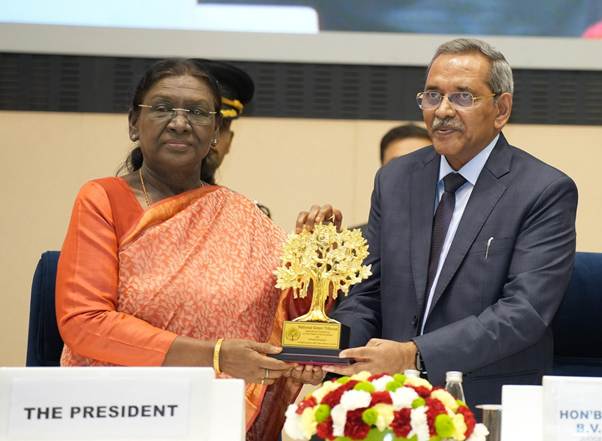
President of India, Droupadi Murmu, today addressed the valedictory session of the National Green Tribunal’s (NGT) two-day International Conference on ‘The Future of Environment and Climate Dynamics’ in New Delhi. The valedictory session was attended by Union Minister for Housing and Urban Affairs, and Power, Manohar Lal; Judge (Supreme Court of India), Justice B.V. Nagarathna; Chairperson (NGT), Justice Prakash Shrivastava; and Solicitor General of India, Tushar Mehta.
In her keynote address, the President lauded the National Green Tribunal for its role in strengthening environmental governance, and laid stress on strengthening climate resilience through people-centric and community-based adaptation approaches rooted in traditional knowledge.
Union Minister Manohar Lal highlighted India’s efforts to balance rapid development with environmental sustainability, noting that non-fossil sources account for nearly 55 per cent of installed generation capacity.
He said India had achieved its 50 per cent non-fossil capacity target five years ahead of schedule.
He also highlighted initiatives in sustainable urban development, water security, public transport, green mobility and electric vehicles, stressing the need for positive collective action to address climate change.
In her speech, Justice B.V. Nagarathna said environmental governance must balance development and conservation, present needs and future interests, while accounting for differentiated impacts across communities and generations.
She highlighted the Supreme Court of India’s shift towards an ecocentric approach and stressed effective institutions, enforcement, transparency, accountability and access to justice.
She said interconnected challenges such as climate change, biodiversity loss, pollution and water scarcity require cooperation among jurisdictions, knowledge-sharing and equitable responsibility among nations.
On the occasion, Manohar Lal released NGT’s Souvenir titled ‘Harit Nyayam’ and presented its first copy to the President of India.
The document chronicles the establishment, growth and achievements of the Tribunal. It is also an important repository for policy makers, legal fraternity and the citizens of the country as it is a lasting reflection of ideas, perspectives and collective resolve that have shaped the two-day conference.