

NewzVille Desk
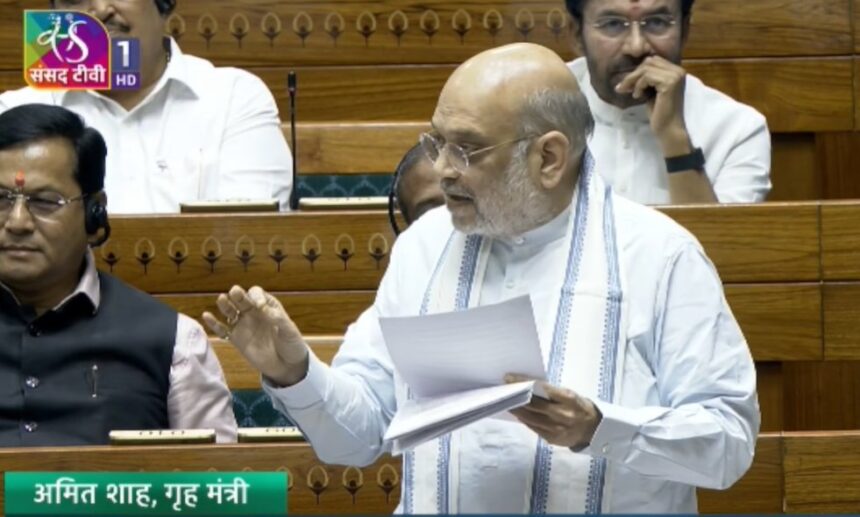
The Central Government introduced three key Bills in the Lok Sabha on April 16, 2026, including the Constitution (One Hundred and Thirty-First Amendment) Bill, 2026, the Delimitation Bill, 2026, and the Union Territories Laws (Amendment) Bill, 2026, aimed at enabling women’s reservation and strengthening democratic representation.
The move comes in the context of the Nari Shakti Vandan Adhiniyam, which provides for reservation for women based on delimitation after the Census to be conducted post-2026.
The government brought these Bills to ensure that women could benefit from 33 percent reservation at the earliest, as waiting for the Census and delimitation process would delay implementation beyond the 2029 general elections.
If passed, the Bills would have enabled women to receive 33 percent reservation in the Lok Sabha as early as the 2029 general elections. Delimitation, which involves finalising constituency boundaries, is essential for implementing reservation.
The proposal also included increasing the number of Lok Sabha seats to around 850 to ensure fair representation, considering the rise in India’s population from 54 crore in 1971 to about 140 crore today.
The government stated that no changes were proposed to the Delimitation Commission Act, and ongoing state elections would not be affected.
Elections up to 2029 would continue under the current system. The proposed increase in Lok Sabha seats is based on a uniform 50 percent expansion, which would maintain proportional representation across states and Union Territories.
The government also clarified that southern and smaller states would not face any disadvantage, as their share in representation would remain stable. For instance, the combined share of five southern states, currently at 23.76 percent, would marginally increase to 23.87 percent after delimitation.
States that have controlled population growth would also not be adversely affected, as the increase in seats would be applied uniformly.
It was further stated that the process of delimitation ensures proportional reservation for Scheduled Castes and Scheduled Tribes, and an expanded House would increase the number of reserved seats.
The government rejected claims that the Constitutional Amendment Bill was introduced to delay the caste census, stating that a time-bound programme for caste enumeration is already underway.
The government noted that reservation based on religion is not provided for in the Constitution, explaining the absence of a separate quota for Muslim women.
It also said that women’s reservation could not be implemented in the 2024 general elections due to the time required for delimitation, which typically takes about two years.
The Women’s Reservation Bill was introduced and passed in 2023 to establish the legal and constitutional framework for reservation through the Nari Shakti Vandan Adhiniyam.
Additionally, a separate Union Territories Laws (Amendment) Bill was introduced to enable implementation in regions such as Jammu and Kashmir, Delhi, and Puducherry, which are governed by separate legal provisions.