

NewzVille Desk
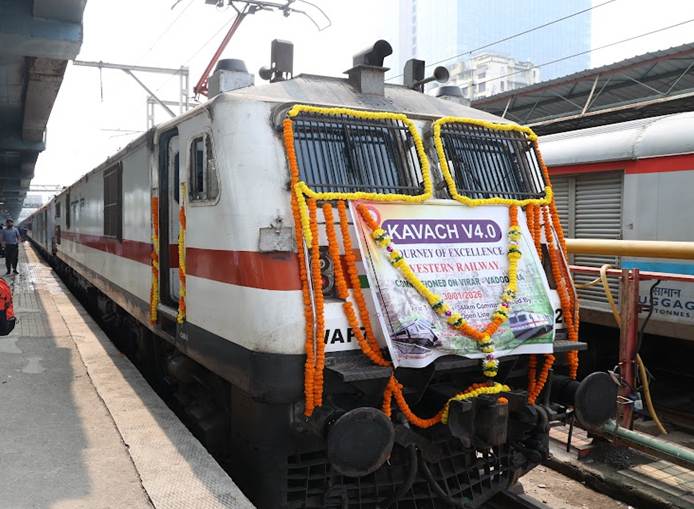
Indian Railways has achieved a landmark milestone today by commissioning 472.3 route kilometres of Automatic Train Protection System, Kavach Version 4.0 across three sections of its network.
The newly commissioned sections include Vadodara–Virar (344 km) on Western Railway, Tuglakabad Junction Cabin–Palwal (35 km) on Northern Railway, and Manpur–Sarmatanr (93.3 km) on East Central Railway.
With this commissioning, Indian Railways continues to accelerate the deployment of the indigenous Kavach system to enhance train protection, operational safety, and reliability across high-density routes.
This commissioning marks the highest ever route kilometres of Kavach commissioned on a single day as well as in a month.
The previous highest commissioning stood at 324 RKm on the Kota–Mathura section of West Central Railway.
With the latest addition, Kavach Version 4.0 has now been commissioned over a total of 1,306.3 Route Kilometres across five zones of Indian Railways.
After Kavach has been successfully commissioned on this 344-km section, the historic milestone was achieved with Dadar–Bhuj Sayajinagri Express (Train No. 20907), becoming the first KAVACH equipped train to run from Mumbai.
About Kavach
Kavach Version 4.0, the latest and most advanced technology of India’s indigenous Automatic Train Protection system, has been developed through continuous technological upgrades based on operational feedback and independent safety assessments.
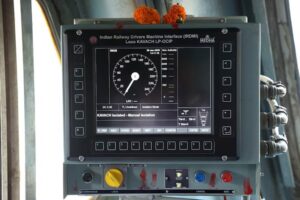
It is specifically designed to address the operational demands of India’s diverse, high-density and multi-line rail network, offering enhanced reliability, faster response, and seamless integration with existing signalling and interlocking systems.
Kavach provides automatic protection against Signal Passing at Danger (SPAD) and effectively prevents side, head-on, and rear-end collisions. It also continuously monitors and controls overspeeding, ensuring safe operations even under low visibility and adverse weather conditions.
In addition, the system generates alerts during wrong-direction and reverse movements and provides automatic information on level crossing gates.