

NewzVille Desk
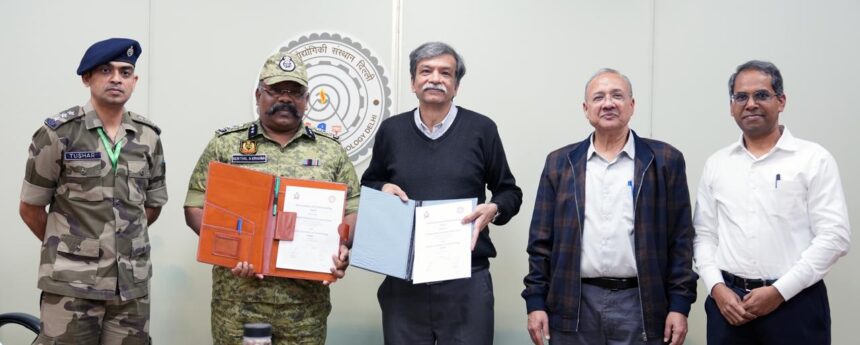
In a major step toward building indigenous, cutting-edge aerial defence for India’s critical infrastructure, the Central Industrial Security Force (CISF) today signed a Memorandum of Understanding (MoU) with the Indian Institute of Technology (IIT) Delhi.
The MoU was signed at the IIT Delhi campus by Senthil Avoodai Krishna Raj S, on behalf of the CISF, and Prof. Rangan Banerjee, Director, IIT Delhi, in the presence of Prof. Ashwini K. Agarwal, Dean (R&D), IIT Delhi.
The agreement establishes a structured framework between the CISF and IIT Delhi in the domain of Drone and Anti-Drone Technology. Core areas of cooperation include:
1. Training and Capacity Building: Conducting specialized technical programmes to equip CISF personnel with advanced operational skills.
2. Research and Development (R&D): Jointly developing practical, indigenous technological solutions aligned with field requirements.
3. Operational Problem Statements: Identifying ground-level security challenges and translating them into actionable academic research.
4. Knowledge Exchange & Consultancy: Facilitating the exchange of research papers, technical ideas, and expert consultancy to stay ahead of evolving unmanned aerial threats.
Designated by the Ministry of Home Affairs (MHA) as the nodal security agency for the aerial security of vital installations, the CISF is proactively studying its operational use cases and threat perceptions across the nation.
Having recently restructured itself along functional sectoral lines—including dedicated verticals for the Airport, Port, Coal, and Power sectors—the CISF recognizes that a one-size-fits-all approach is insufficient against modern drone threats. Each sector demands distinct technological capabilities:
1. Airport Sector: Requires high-precision detection and non-disruptive counter-drone measures to protect sensitive flight paths and crowded terminals.
2. Port Sector: Faces unique maritime and coastal aerial threat perceptions requiring specialized perimeter defence.
3. Coal and Power Sectors: Demand wide-area surveillance, night-vision capabilities, and continuous monitoring across vast industrial terrains.
Collaborating with premier research institutions enables the CISF to co-develop customized, practical security solutions tailored to the exact operational realities of each sector.
The pact with IIT Delhi marks the fifth major collaboration between the CISF and the Indian Institutes of Technology (IITs), significantly expanding the force’s academic and technological footprint. Prior to this, the CISF has signed key MoUs with:
1. IIT Ropar: Focused on specialized cybersecurity and technology capabilities for critical aviation infrastructure.
2. IIT Kanpur: Twin MoUs covering cybersecurity training via C3iHub and a five-year collaboration to develop the Centre of Excellence (CoE) in Drone and Anti-Drone Technology at MPRTC Behror, Rajasthan.
3. IIT Madras (Pravartak): Focused on specialized technology and security training.
4. IIT Hyderabad (TiHAN): Focused on autonomous navigation, specialized drone training for NISA trainees, and technical support for countering aerial threats.