

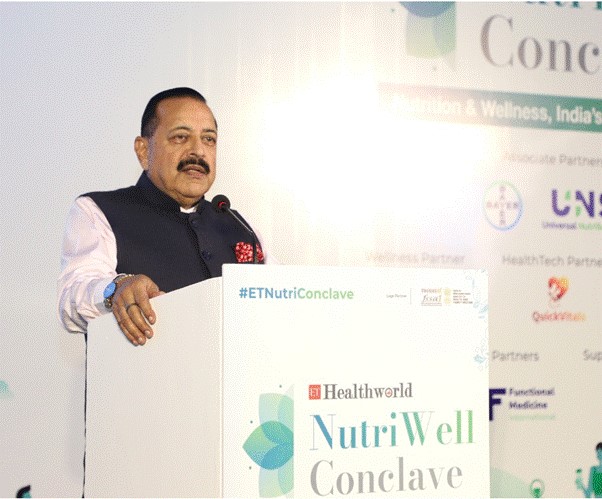
NewzVille Desk
India is steadily strengthening its indigenous nuclear energy ecosystem with a focus on advanced reactor technologies, Small Modular Reactors (SMRs), domestic manufacturing capabilities, private-sector participation and long-term utilisation of the country’s abundant thorium resources, Minister of State for Personnel, Public Grievances & Pensions and Prime Minister’s Office, Dr. Jitendra Singh, said in a written reply in the Lok Sabha today.
Dr. Jitendra Singh said India’s long-term nuclear energy strategy continues to be guided by the country’s three-stage nuclear power programme, aimed at sustainable utilisation of its vast thorium reserves for long-term energy security. The strategy has received further impetus through the Nuclear Energy Mission announced in the Union Budget 2025-26, with an objective of expanding nuclear energy capacity to 100 GWe by 2047.
The Government has adopted a two-pronged approach to accelerate nuclear capacity addition. This includes deployment of large indigenous reactors such as 700 MWe Pressurised Heavy Water Reactors (PHWRs) and advanced reactor designs at greenfield sites, alongside development and deployment of Small Modular Reactors (SMRs) at brownfield locations, including retiring fossil-fuel-based power plants, captive plants for energy-intensive industries and off-grid applications in remote areas.
A key objective under the Nuclear Energy Mission is to develop and operationalise at least five indigenous SMRs by 2033. The Bhabha Atomic Research Centre (BARC), a constituent unit of the Department of Atomic Energy (DAE), is undertaking the design and development of indigenous SMR technologies, including the 220 MWe Bharat Small Modular Reactor (BSMR-200) and 55 MWe SMR-55 for power generation. BARC is also developing a High Temperature Gas Cooled Reactor (HTGCR) of up to 5 MWth capacity, which can be coupled with a suitable thermochemical cycle for hydrogen production.
Dr. Jitendra Singh also highlighted the continuing work of the Indira Gandhi Centre for Atomic Research (IGCAR) in advancing the second stage of India’s nuclear power programme. IGCAR is pursuing multidisciplinary scientific research and advanced engineering development for Sodium Cooled Fast Breeder Reactors and associated closed fuel-cycle facilities, technologies that remain a cornerstone of India’s long-term nuclear strategy.
Emphasising the Government’s efforts to create a broader domestic nuclear ecosystem, Dr. Jitendra Singh said the Sustainable Harnessing and Advancement of Nuclear Energy for Transforming India (SHANTI) Act, 2025 has been enacted to enable wider participation of both public and private entities in the nuclear sector.
The Department of Atomic Energy is encouraging Indian industry through knowledge-sharing and handholding for new SMR technologies, while simultaneously developing domestic nuclear vendors and strengthening the private-sector R&D ecosystem. Critical components such as low-alloy steel forgings for reactor pressure vessels and reactivity control drive mechanisms have already been realised through domestic industry, while development of other critical equipment has also been initiated with domestic industry and start-ups.
The reforms under the SHANTI Act envisage greater participation of private entities in nuclear manufacturing, engineering services, research and development and supply chains, while maintaining stringent standards of nuclear safety, security and safeguards. The Act also provides statutory status to the Atomic Energy Regulatory Board, thereby reinforcing the framework for robust regulatory oversight.