

NewzVille Desk
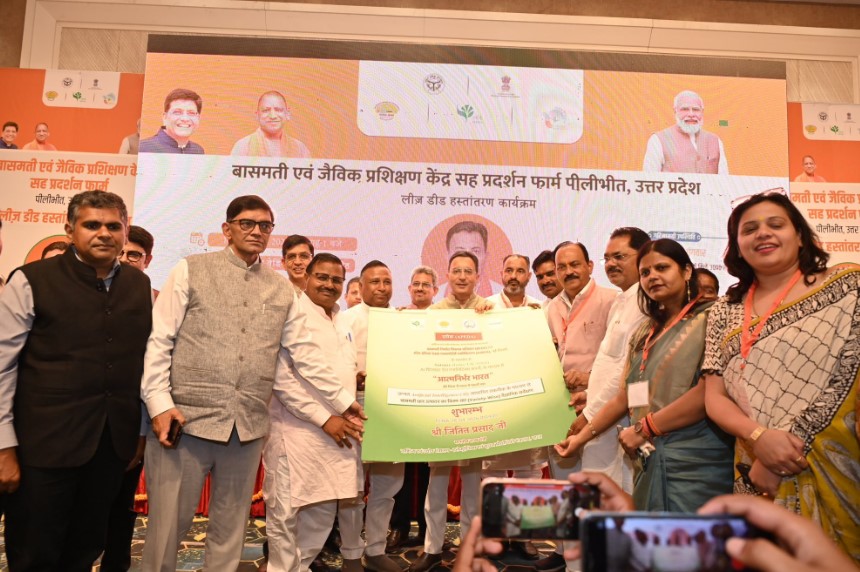
To create a Basmati rice ecosystem in India, the transfer of land for the establishment of a Basmati & Organic Training Centre-cum-Demo Farm at Tanda Bijaisi, Pilibhit, has been formalised through the signing of a 70-year lease agreement between the Agricultural and Processed Food Products Export Development Authority (APEDA), the Department of Agriculture, and the Government of Uttar Pradesh.
The proposed Basmati & Organic Training Centre-cum-Demo Farm will be developed over an area of approximately seven acres. The centre will be equipped with facilities including an auditorium, museum and gallery on Basmati and organic farming, conference room, laboratory and storage space for organic farming inputs.
The facility is expected to support training and capacity building for Basmati and organic farmers, and also serve as a resource centre for agricultural experts and students.
Once established, the facility will be the country’s first Basmati organic training and demonstration farm covering both conventional and organic Basmati cultivation. Owing to its location, the centre is expected to benefit farmers and stakeholders in Uttar Pradesh and Uttarakhand.
Addressing the gathering, Union Minister of State for Commerce and Industry and Electronics and Information Technology, Shri Jitin Prasada, appreciated the initiative and highlighted the potential of Pilibhit as a major Basmati-producing region. He emphasised the importance of expanding organic cultivation and called for greater farmer engagement. Shri Prasada suggested incorporating an AI-based interactive museum at the centre to provide information and experiential learning for visitors and students, along with establishing a dedicated outlet for quality Basmati seeds and organic inputs for farmers.
On the occasion, Shri Jitin Prasada also unveiled India’s first AI-based Basmati Paddy Survey project (2026–2028), to be implemented by APEDA in collaboration with the All-India Rice Exporters Association (AIREA). The project will cover nearly 4 million hectares, collect data from over 150,000 ground-truth points and engage with more than 500,000 farmers. It aims to support precise crop assessment, varietal identification, scientific advisory services and improved export planning.