

NewzVille Desk
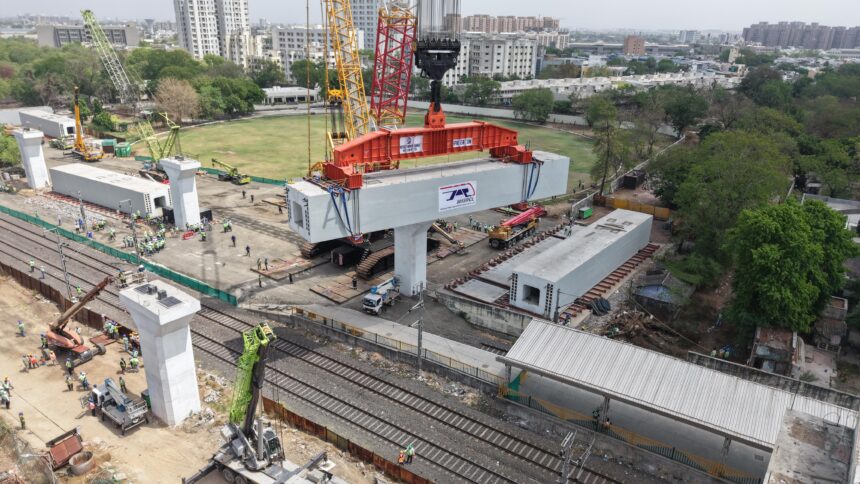
One of the heaviest precast-prestressed portal beam (girders), weighing approximately 1360 metric tonnes has been launched over the Amdavad–Vadodara railway line in Maninagar for Mumbai-Ahmedabad Bullet Train project.
The portal beam is a precast concrete structure measuring 34 metres in length, with a cross-section of 5.5 metres by 4.5 metres.
A total of five such beams are planned for installation near Maninagar railway station in Maninagar. These beams are being precast at site and erected as heavy integrated units.
The complete launching activity was executed under strict safety protocols with a remarkable short duration of approximately 3.5 hours.
This was achieved during a full traffic and power block coordinated with Indian Railways. The same operation was earlier planned with long-duration caution orders extending up to six months and requiring blocks of nearly 9 hours.
Through meticulous planning and optimization, the execution time was significantly reduced to just 3.5 hours for both lines of the Amdavad–Vadodara section.
The lifting operation was carried out using a 2200 MT crawler crane as the primary equipment, supported by auxiliary machinery including a 260 ton standby crane, an 80 ton crane, man lifters, and a lifter beam system with anchoring frames.
The lifting arrangement utilized prestressed macalloy bars of 75 mm diameter, along with lifting beams and heavy-duty slings to safely handle the massive load.
The operation presents several engineering challenges, including handling an ultra-heavy lift of around 1360 MT—one of the heaviest lifts executed over Indian Railways infrastructure along with the necessity to complete the entire erection within a short time window.
Additional complexities arise from restricted working space, the presence of overhead equipment (OHE), and multiple active railway lines, all of which demand high precision during placement at an approximate pier height of 15 m, real-time coordination with railway authorities, deployment of redundant lifting systems and rigorous rigging checks, continuous wind speed monitoring due to the large exposed surface area of the beam, and precise survey and alignment control to ensure safe and accurate installation.