

NewzVille Desk
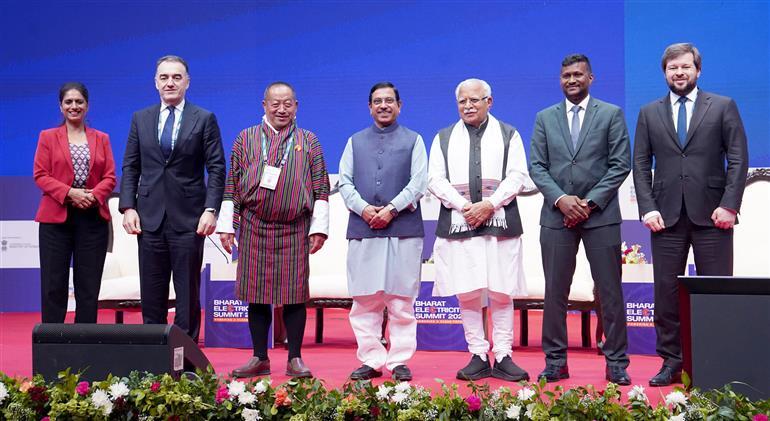
Union Minister of Power Manohar Lal inaugurated the four-day global Conference-cum-Exhibition ‘Bharat Electricity Summit 2026’, at Yashobhoomi, New Delhi today. Pralhad Joshi, Minister of New and Renewable Energy, Government of India; Shripad Naik, Minister of State for Power and New & Renewable Energy, Government of India; Pankaj Agarwal, Secretary, Ministry of Power, Government of India; Ghanshyam Prasad, Chairperson, Central Electricity Authority (CEA) were also present during inauguration.
The Bharat Electricity Summit 2026 is hosting more than 100 high-level conference sessions featuring over 300 speakers, representatives from more than 80 countries, over 500 exhibitors including over 100 startups and more than 25,000 visitors, making it one of the largest electricity-focused platforms globally.
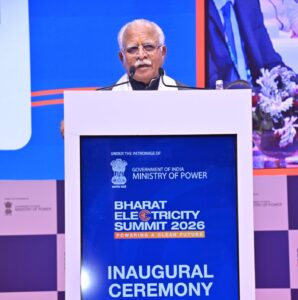
Minister Lal, in his keynote address, hailed India’s achievements of transition from power deficit to a power surplus nation, exponential growth in solar energy capacity from 2.8 GW solar capacity to over 143 GW today.
The Minister also highlighted India’s remarkable progress with a 72% expansion in transmission infrastructure to over 5 lakh circuit kilometers, meeting 250 GW peak demand in 2024-25 and being fully prepared to meet peak demand of 270 GW and beyond, while positioning itself as a future global exporter of affordable energy as the backbone of India’s vision to become a developed nation by 2047, he also outlined initiatives such as cross-border energy connectivity, undersea transmission networks.
Pralhad Joshi emphasized that while thermal power will continue to serve as the backbone of the energy system, renewable energy represents the only sustainable long-term pathway, underscoring the need for a balanced transition driven by scale, speed, and skill.
Shripad Naik highlighted that India’s installed power capacity has more than doubled since 2014, with renewable energy witnessing exponential growth, from 2.8 GW solar capacity to over 143 GW today.
He emphasized that over 32 lakh households and 23 lakh farmers are already contributing to clean energy generation, reflecting a shift towards a participative energy economy.
Pankaj Agarwal stated that India now operates one of the world’s largest synchronised grids, supported by advanced balancing systems, large-scale smart meter deployment and strong policy frameworks.
During the inaugural session, the Ministry of Power released key strategic reports including the National Resource Adequacy Plan, outlining a comprehensive roadmap to meet India’s growing electricity demand through a balanced energy mix, and the Transmission Plan for Integration of over 900 GW Non-Fossil Fuel Capacity by 2035-36.