

NewzVille Desk
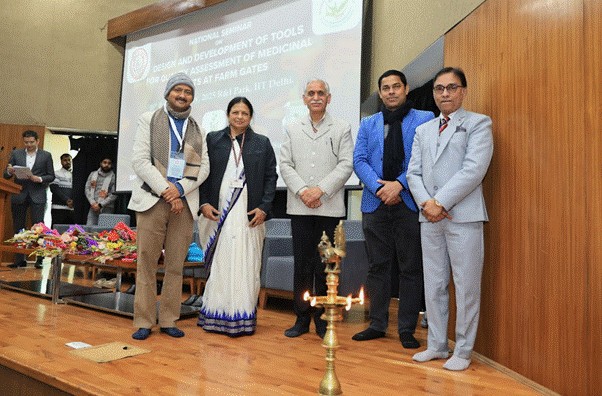
A National Seminar on “Design and Development of Tools for Quality Assessment of Medicinal Plants at Farm Gates” was held recently at the Indian Institute of Technology (IIT) Delhi, bringing national focus to India’s medicinal plant sector—assured quality, traceability, and standardisation of raw materials at the point of origin.
The seminar was inaugurated and addressed by Prof. Dr. Mahesh Kumar Dadhich, Chief Executive Officer, NMPB, and Prof. Dr. Tanuja Nesari, Director, Institute of Teaching and Research in Ayurveda (ITRA).
The two-day seminar set the national policy and scientific context for quality-driven growth, emphasising the need to integrate innovation, regulation, and traditional knowledge to build global confidence in Indian medicinal plant raw materials.
The seminar convened policymakers, scientists, technologists, industry leaders, and researchers to deliberate on strengthening farm-gate quality systems as a foundation for the sustainable growth and global competitiveness of India’s Ayush and medicinal plant ecosystem.
Technical sessions on Day One examined the entire medicinal plant value chain—from sustainable cultivation and regenerative agriculture to AI-enabled quality assessment, digital traceability, and supply-chain integration.
Experts from ICAR–Directorate of Medicinal and Aromatic Plants Research (DMAPR), IIT Delhi, the World Health Organization (WHO), the Ministry of Ayush , Central Council for Research in Ayurvedic Sciences (CCRAS), Himalaya Wellness, and Herbalscape Crops shared evidence-based insights and field experiences.
Day Two was dedicated to roadmap building through two structured expert brainstorming sessions on Integration of Artificial Intelligence in the Indian Medicinal Plant Industry, and use of Blockchain Technology for Supply-Chain Transparency and Traceability.
The sessions resulted in a strong consensus that digital tools at the farm gate—such as portable quality-testing devices, AI-enabled decision-support systems, and blockchain-based traceability platforms are essential to ensure authenticity, safety, and global competitiveness of Indian herbal raw materials.
The seminar also highlighted the integration of traditional knowledge systems such as Vriksha Ayurveda with modern quality-control frameworks, demonstrating how India’s heritage can be scientifically validated and digitised to strengthen global acceptance.
Strong emphasis was placed on capacity building, with participants gaining exposure to advanced tools, standards, and evolving policy directions.
The seminar laid a robust foundation for developing a national framework for AI-enabled, traceable, and standardised medicinal plant supply chains.
The outcomes directly support the national priorities of Atmanirbhar Bharat and Make in India, while reinforcing India’s leadership in the global Ayush sector.