Winter in Japan’s Kansai region is a season of beautiful memories to add in your diary. You can find yourself standing in the silent, snow-dusted serenity of a mountain temple, and in the middle of a glowing, city festival the next and unforgettable traditional cuisines.
Here is a look at the magnificent experiences that define the region during the colder months.
Lively Festivals
Toka Ebisu is a bustling winter festival and an example of how traditional beliefs still thrive in Japan amid contemporary urban culture. The festival held every year from 9-11 January, in western Japan, in honor of Ebisu, the kami of prosperity.
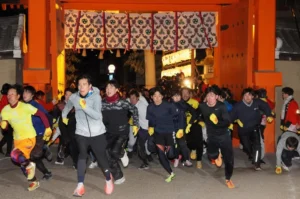
At Osaka’s Imamiya Ebisu Shrine, the lanterns glow warmly all night during the festival, illuminating a compound filled with worshipers eager to receive fukuzasa, bunches of bamboo grass adorned with auspicious symbols.
These are distributed by fukumusume, or “girls of good fortune,” traditional mediators of the relationship between worshipers and Ebisu. They utter of “Shobai hanjo de sasa motte koi!” means “Bring some bamboo grass and your business will prosper!”.
Photo Credit: Kizuna
On January 10, when the gates are thrown open at 6 a.m. at the Shrine, crowds of worshipers race the 230 meters to the main building, where the first three to arrive are hailed as fukuotoko, or “men of good fortune”, harbingers of good times ahead in the coming year.
The cries are an iconic part of the Toka Ebisu festival. Having received their fukuzasa, worshipers make cheerful prayers for another good year.
These bright, colorful winter vistas are symbols of the coexistence of humanity and nature.
Flavorful Foods
Zoni is a soup enjoyed throughout Japan at New Year’s season. Mochi (Rice Cake) dumplings are the standard ingredient, but regional variations abound.
Photo Credit: Kizuna
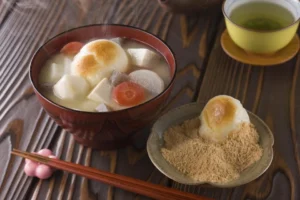
In Japan’s Nara city, zoni is usually made with white miso stock for a milder flavor. The dumplings are round, symbolizing wishes for a harmonious (round and full) year for the family, and the vegetables added are cut into round slices.
Nara zoni is also notable for the fact that the mochi in it is eaten after dipping it in a separate plate of sugared kinako (roasted soybean powder).
In some parts of Japan where mochi is removed from the zoni and then flavored differently before eating.
In Nara, though, this kind of “flavor change” is part of the zoni experience, making it a unique dish where the varying flavors are part of the fun.
Natural Beauty
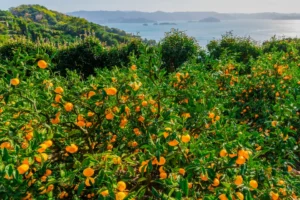
Wakayama Prefecture produces around one-fifth of Japan’s mikan (the mandarin orange Citrus unshiu), making it the country’s leading source of the fruit.
Photo Credit: Kizuna
Arida Mikan, cultivated in the prefecture’s central Arida region for more than 450 years, are one of the country’s best-known mikan brands.
In 2025, ‘The Stone Terraced Mikan Orchard System of Arida-Shimotsu Region’ was officially recognized as a Globally Important Agricultural Heritage System by the Food and Agriculture Organization of the United Nations.
Founded in 2024, NewzVille has got some name and fame. With more than 28 years of long journalistic career, the Editor-in-Chief had remained in various key positions at News Today Pvt Ltd, ETV Networks, Lok Sabha TV, Rajya Sabha TV, and Sansad TV.
As an accredited Video Journalist for more than 17 years under Ministry of Information &Broadasting, Government of India covered State Visits of Prime Minister and Vice President.
With coverage spanning 2 General Elections and more than 18 Assembly Elections, notable work includes national security series, live chamber telecasts, and audience-favorite documentaries.
Key interests remain in Documentaries on Armed Forces and Travelogues.