
NewzVille Desk
Union Minister for Railways, Ashwini Vaishnaw, today announced that in line with Indian Railways’ resolve to undertake reforms during 2026, five new reforms have been approved making it to nine.
Vaishnaw said that under the ongoing “Reform Express” initiative, four reforms had already been announced and five new reforms are being introduced. Out of the five new reforms, two are related to cargo, one to construction, and two to passenger convenience.
Reform in Salt Transportation
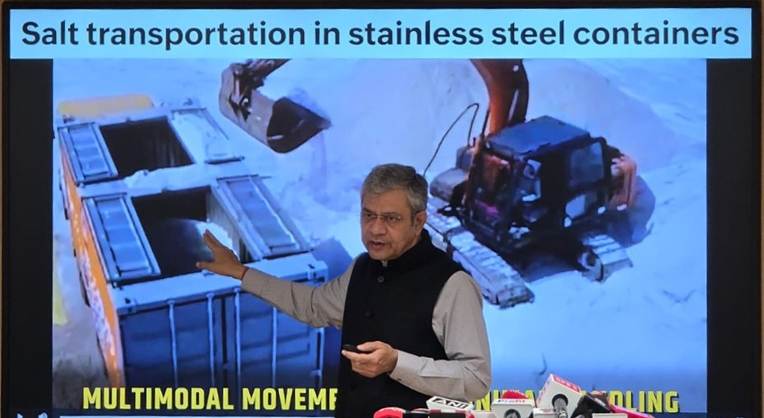
Speaking on reform number five, which focuses on salt transportation, Vaishnaw said India is one of the largest producers and exporters of salt in the world.
The three major producing states are Tamil Nadu, Gujarat, and Rajasthan. Out of nearly 35 million tonnes of salt produced annually in India, about 9.2 million tonnes per annum are transported by railways, reflecting a significant untapped opportunity.
He informed that 62 per cent of all rail-based salt traffic covers distances of 1,000 to 2,500 kilometres, making it a segment well-suited for rail movement.
He said detailed consultations were held with salt producers and transporters to understand the challenges. The study identified key issues, including unsuitable wagon design, corrosion of wagons caused by salt, water seepage in open wagons despite tarpaulin covers, and multiple handling stages leading to higher costs and losses.
To address these issues, a stainless steel, top-loading and side-discharge container system has now been successfully developed to prevent corrosion, and is equipped with top-loading flaps and a hydraulic side-discharge mechanism, allowing easy unloading into trucks at the destination.
Reform in Automobile Transportation
The Indian automobile market produces approximately 31 million units annually, of which passenger vehicles account for around 5 million units. The rail co-efficient in passenger vehicle transport stands at about 24 per cent, indicating that a large share of automobile movement still happens by road.
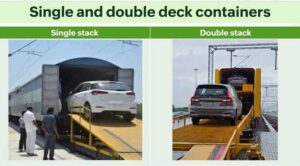
He said feedback from the industry highlighted key design and operational constraints. The major automobile production hubs served by railways include Mahesana in Gujarat; Chinchwad and Bidadi in Maharashtra and Karnataka; Penukonda in Andhra Pradesh; Melpakkam and Walajabad in Tamil Nadu; and Farakhanagar in Gurugram, Haryana. He stated that earlier initiatives included converting existing passenger coaches into automobile carrier wagons and introducing new solutions. However, further consultations revealed that the primary issue lay in the design of automobile carrier wagons.
The Union Minister said that the existing wagon designs were either suited for single-stack or double-stack configurations, limiting flexibility. He added that many routes face restrictions due to tunnels and bridges, where the Schedule of Dimensions (SOD) constraints prevent movement of certain wagon types.
To address this, Vaishnaw said the Railways has introduced a reform allowing special wagon designs while giving flexibility to the industry. Manufacturers can now design wagons based on specific origin-destination routes with high-capacity.