

NewzVille Desk
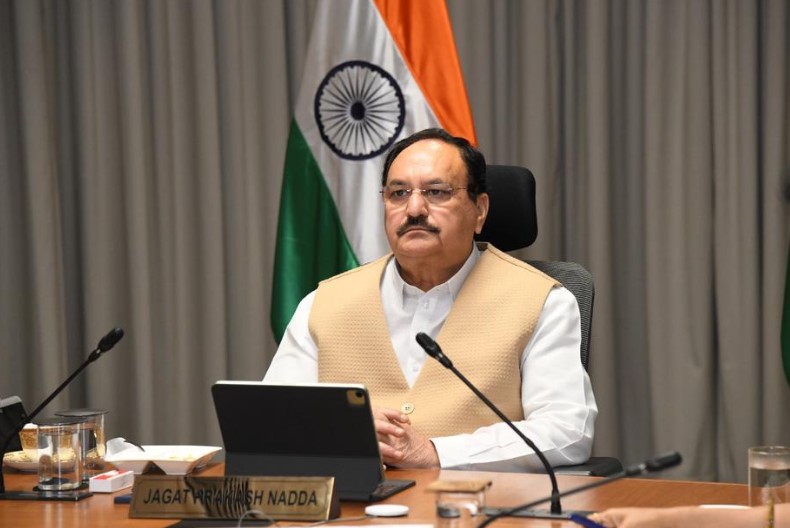
Union Health Minister Jagat Prakash Nadda has reaffirmed India’s strong commitment to eliminating cervical cancer as a public health problem and strengthening global health cooperation. Virtually addressing a press briefing on global health issues with the World Health Organisation (WHO) Director General Tedros Adhanom Ghebreyesus, the minister said India has adopted a multi-pronged strategy to combat the disease, focusing on prevention, screening, early detection and timely treatment.
He said screening services for cervical cancer using Visual Inspection with Acetic Acid (VIA) are now available at Ayushman Arogya Mandirs and other health facilities for women between 30 and 65 years of age.
Under the National Programme for Prevention and Control of Non-Communicable Diseases, over 86 million women have already been screened across the country.
Nadda also highlighted the nationwide vaccination campaign against Human Papillomavirus (HPV). He said the campaign was launched on 28th February by Prime Minister Narendra Modi and aims to vaccinate about 12 million adolescent girls aged 14 years.
The vaccination drive will run for 90 days and follows a single-dose schedule using the Gardasil Quadrivalent vaccine, which is being provided free of cost at government health facilities.
The Union Health Minister said the initiative reflects the vision of Swasth Nari, Sashakt Parivar, placing prevention and equitable healthcare for women at the centre.
He added that the programme is voluntary and based on parental consent, respecting community values. Reaffirming India’s global commitment, he said the country fully supports the WHO global strategy to eliminate cervical cancer and achieve the 90-70-90 targets by 2030, which include vaccination of 90% of girls, screening of 70 per cent of women and treatment of 90 per cent of women diagnosed with cervical disease.
Furthermore, the WHO Director General praised India’s efforts and described the nationwide HPV vaccination campaign as the world’s largest free vaccination drive, calling it a landmark step toward eliminating cervical cancer.