

NewzVille Exclusive
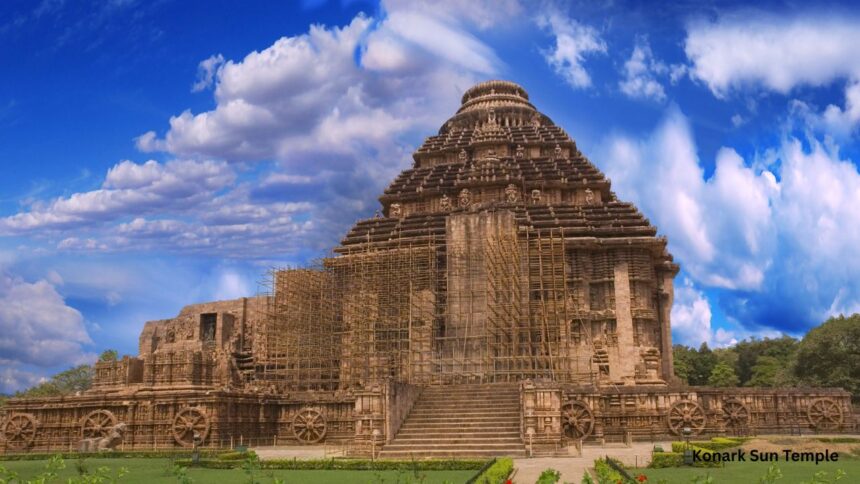
There are monuments that look stunning in photographs, and then there is the Konark Sun Temple. While a high-definition image can capture its geometry, it fails to transmit the sheer, crushing weight of its history or the vibration of its stone. Inscribed as a UNESCO World Heritage Site in 1984, this 13th-century marvel remains one of humanity’s most ambitious architectural statements.
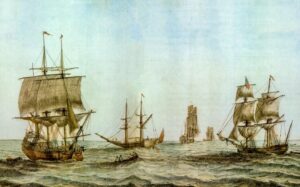
The Konark Sun Temple came to be known as the Black Pagoda because European sailors—such as the Portuguese, Dutch, Danish, French, and British—used this towering monument as a prominent navigational landmark along the Odisha coast while sailing in the Bay of Bengal from the beginning of the 16th century.
Led by seven horses, the Konark temple is known for its formation of a huge chariot representing Surya, the Sun God. The wheels fitted to the chariot symbolizing riding the ‘kaal'(of different era) day in and day out.
The story behind the monumental structure is obviously very interesting, but more intersting is what you will get to know here and now.
As you know how Dharmapada, the twelve-year-old son of Bishu Maharana, a master sculptor from the traditional temple-building (shilpi) community, completed the final work of the Konark Sun Temple and sacrificed himself by leaping into the Chandrabhaga River to save the lives, honour, and craft of the 1,200 artisans.
There is another story of how these big stones being transported to construct one of the world’s greatest human engineering work. The search, research story has brought to the table by a scholar Susanta Bahiinipati.
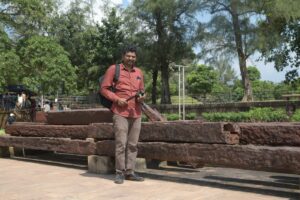
Bahinipati works as an Assistant Professor at the School of Film and Media Sciences, KIIT Deemed to be University, Odisha. One of his research work in recent days got 4th place for Esri India StoryMaps Challenge.
With doing his PhD at Mansarovar Global University, Sehore, Madhya Pradesh, his research titled “Revealing the Ancient Engineering Marvel: Waterways Behind the Black Pagoda’s Construction” was appreciated in various academia and scholars.
On ‘how the idea came to mind’, Susanta Bahinipati says, “The motivation behind this research is deeply personal and rooted in childhood memory. While listening to the story of Dharmapada from my mother during my early years, I found the narrative both moving and intellectually stimulating.”
“Later, when I studied Pandit Gopabandhu Das’s poem Dharmapada, my teacher clearly explained the reference to a water body near the Konark Sun Temple. However, when I visited the site myself, I found no such visible water source. This absence became my first moment of curiosity and the initial impulse for undertaking this study,” he added with speculation of mystery.
With repeated visits, he was anxious to know, how the sheer size of the stones transported to such monumental heights? How were these massive stones brought to the site and lifted during the 13th century? These questions led the direction and purpose of his research.
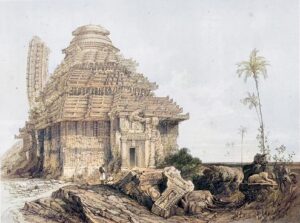
The research is ongoing to determine the exact position of the sea at the time of the temple’s construction. Based on preliminary GIS-based findings, the coastline was significantly closer to the Konark Sun Temple in 1570 AD, at approximately 1.65 kilometers, compared to about 3.2 kilometers at present.
The StoryMap tells the mystery, retracing vanished waterways and coastal transformations through rare historical maps, folk memories, and satellite imagery.
It will take you on-board on a geo-historical journey to discover how water once powered the engineering and construction of one of the world’s greatest architectural wonders.
According to the research work, Geomorphological studies and GIS reconstructions reveal ancient channels and lagoons that transported massive stone blocks during construction. The nearby port of Khalkatapatana served as a logistical hub, while the “Sar” lake, documented in European maps, functioned as a tidal reservoir aiding construction.
Archaeological surveys reveal traces of embankments, silted channels, and boat-shaped depressions; evidence of a vibrant harbor accommodating large wooden ships.
In the 13th century, when King Narasimhadeva-I began construction of the Sun Temple, Khalkatapatana became the primary supply point. Massive stone blocks weighing hundreds of tonnes arrived via coastal routes, then moved inland through canals and waterways.
The port enabled efficient transport of Khondalite, laterite, chlorite, iron ores, tools, elephants, and manpower.
The ‘Sar’ Lake, an ancient reservoir was vital to Konark’s creation. The Lake connected the temple site with nearby rivers and the Bay of Bengal, forming a larger hydrological network.
The research by Prof. Bahinipati is furthure going to add new dimensions and help the future students of history, architecture, geology and marine science studies.
Prof. Bahinipati on his research work says “I sincerely appreciate the care taken in presenting the journey, context, and impact of the work, and I am grateful for the effort put into documenting this recognition so meaningfully.
If someone wants to know the nuances of this research work, the links are given below:
https://storymaps2025.esri.in/portal/apps/storymaps/stories/ba6857ceef8a42ca8de9e0fbced8425b
https://f1000research.com/articles/13-1540