

NewzVille Desk
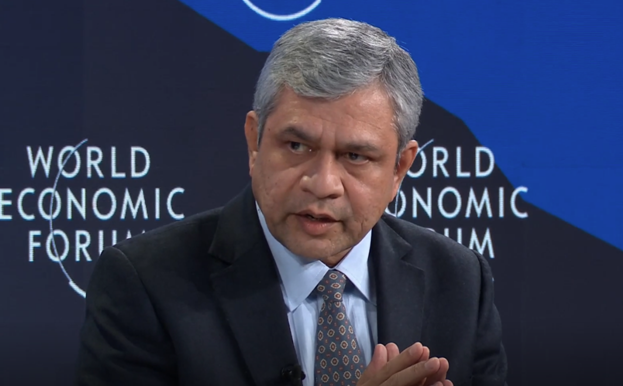
Union Minister for Electronics and IT, Railways, and I&B Ashwini Vaishnaw highlighted India’s comprehensive approach to artificial intelligence, semiconductors, and deep-tech innovation during interactions at the World Economic Forum Annual Meeting 2026, Davos, Switzerland.
Speaking on the upcoming AI Impact Summit, Vaishnaw said it will focus on three key objectives: impact, accessibility, and safety. The Summit aims to improve efficiency, create economic multipliers, expand AI access for India and the Global South, and build regulatory and safety frameworks.
Global leaders, technology executives, and investment announcements are expected at the event.
The Minister noted that India hosts nearly 2,00,000 startups, among the top three ecosystems globally, with a growing focus on deep tech. Twenty-four startups are designing semiconductors, with 18 already receiving venture funding, reflecting confidence in India’s technological capabilities.
Vaishnaw outlined India’s semiconductor roadmap, starting with mastering 28nm–90nm manufacturing for sectors including EVs, railways, defence, telecom, and consumer electronics. India aims to reach 7nm by 2030 and 3nm by 2032, targeting a position among the top four to five semiconductor nations worldwide.
On regulation and governance, Vaishnaw underscored the importance of a techno-legal approach to AI regulation.
He said regulation cannot rely solely on laws but must be supported by technical tools that mitigate harms such as bias and deepfakes.
“For example, deepfake detection systems must have accuracy that can stand scrutiny in courts,” he said, adding that India is developing technologies to detect deepfakes, mitigate bias, and ensure proper unlearning of models before enterprise deployment.
Google Cloud CEO Thomas Kurian and Meta’s Joel Kaplan also participated with Ashwini Vaishnaw discussing AI investment in India, including a $15 billion AI data centre in Vizag, and safety of social media users from deepfakes and AI-generated content.
Vaishnaw explained India is developing the entire AI stack—from applications, models, and chips to infrastructure and energy.
He said small AI models currently handle 95% of workloads, and India is creating a suite of 12 efficient, affordable sovereign AI models for enterprise use.
The Minister highlighted $70 billion in confirmed AI infrastructure investment and the opening of nuclear energy to private sector participation, which will support the AI ecosystem.
He stressed that India is leveraging government demand for AI in sectors such as agriculture, healthcare, and weather forecasting, while collaborating with industry to skill students for AI-driven industrial transformation.
Vaishnaw said, India’s AI strategy is centred on efficiency, affordability, sovereignty, and innovation, positioning the country to compete effectively in the global AI race.
Global leaders, technology executives, and investment announcements are expected at the event.